There is a number that quietly separates the businesses that stay booked from the ones that keep complaining their leads are junk. It is five minutes. A lead-response study out of MIT found that reaching a new web lead within five minutes instead of thirty made you around 100 times more likely to actually connect with them, and about 21 times more likely to qualify them. Same lead. Same offer. The only thing that changed was how long it sat before someone picked up the phone. Five minutes is not a target you hit when you get around to it. It is the line where a warm lead turns into a cold one.
01Where the five-minute rule comes from
The five-minute rule is not a slogan someone made up to sell software. It comes from research, and the research is old enough that it has held up for more than a decade.
The MIT study, often tied to Dr. James Oldroyd, timed responses to inbound web leads and compared the outcomes. The finding that stuck was the drop-off. Wait from 5 minutes to 30 and your odds of connecting fall by roughly 100 times. Your odds of qualifying the lead fall by about 21 times. The curve is steepest right at the start, which is why the first five minutes carry so much weight.
Put another way, the difference between calling at minute 5 and minute 30 is not “a little worse.” It is the difference between talking to a live person and leaving a voicemail they never return.
02What is actually happening inside those five minutes
The rule sounds almost too strong until you think about what the person on the other end is doing.
They just filled out your form. Right now, in this minute, they are still holding their phone, still thinking about the exact problem that made them reach out, and still undecided about who to trust. Their attention is on you, or at least on the thing you fix. This is the one moment where a call feels like help instead of an interruption.
Now let the clock run. At ten minutes they have set the phone down and gone back to their day. At thirty they are in a meeting, or driving, or onto something else entirely. By the time you call, the problem is no longer the loudest thing in their head, and you are competing with everything that has happened since. The lead did not get less interested in fixing their problem. They just stopped thinking about you specifically. That is what “went cold” really means, and it happens fast. I broke down the minute-by-minute version of this in how fast you really need to call a new lead.
03Why almost everyone misses the window
If five minutes matters this much, why does almost every business blow past it? Because the way most businesses handle leads makes five minutes nearly impossible.
A lead comes in as an email or a text notification. That notification lands while you are on a job, with a customer, or asleep. You see it later. You mean to call back. Later becomes tonight, tonight becomes tomorrow, and the five-minute window closed before you ever knew the clock was running.
The Harvard Business Review looked at this across 2,241 companies and found the average first response was 42 hours. Not 42 minutes. Hours. Only 37 percent even managed to respond within an hour, and nearly a quarter never responded at all. So the bar is not really “beat five minutes.” For most businesses it is “beat two days,” which they are also losing. The five-minute rule feels aggressive only because the average is so slow.
04The cost of being five minutes late, in real terms
It is easy to treat a missed lead as a rounding error. It is not, and the math is worth doing once.
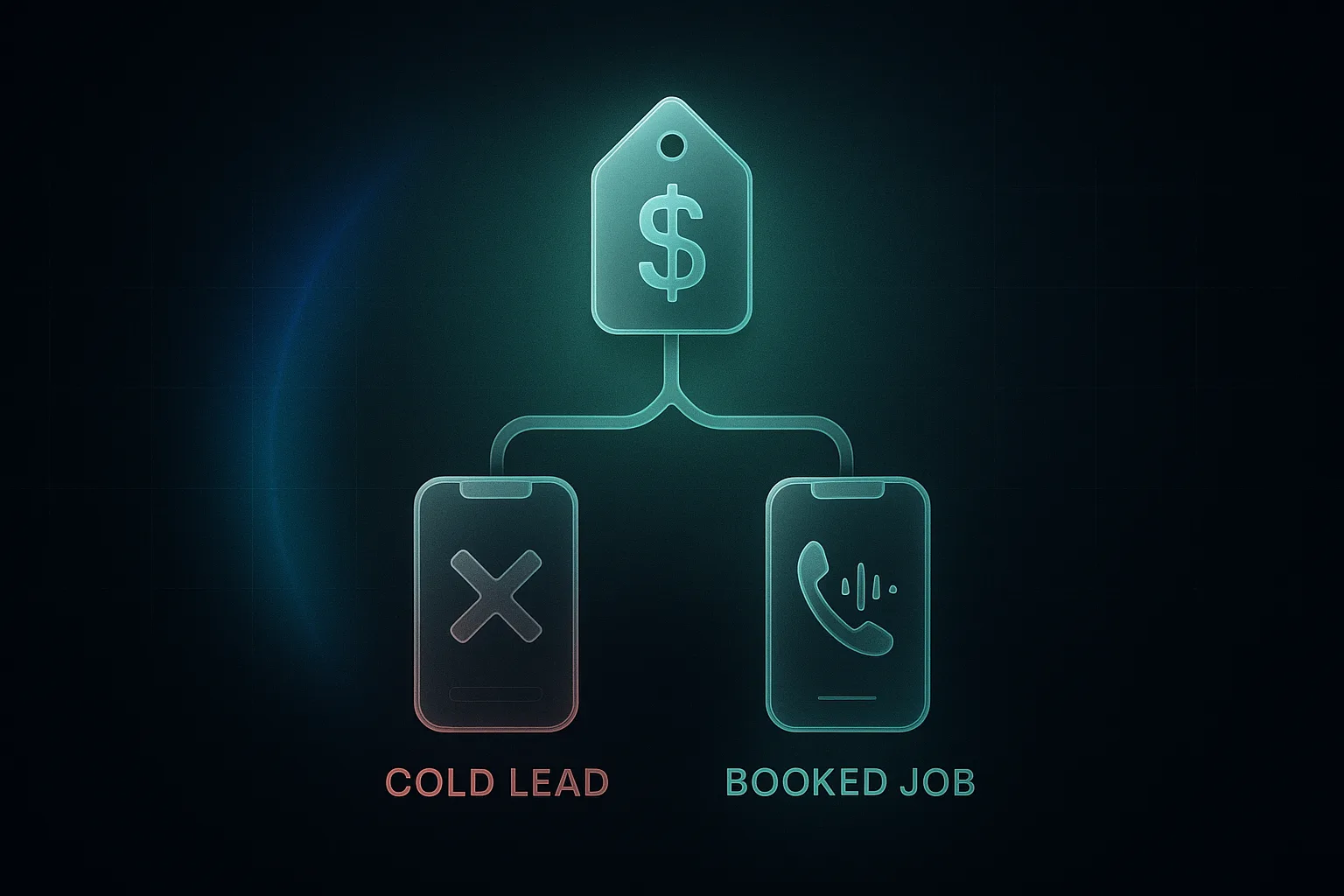
Say you buy leads for 40 dollars each and you close a booked appointment into a job worth a few hundred to a few thousand dollars. Every lead that goes cold because you called at hour two instead of minute two is not just a lost sale. It is 40 dollars you already spent, plus the job you would have booked, plus the fact that the lead almost certainly booked with whoever did call first. You paid to create demand and then handed it to a competitor.
Stack that up over a month. If even a handful of leads a week slip past the window, that is a real number of jobs walking out the door, funded by your own ad budget. The businesses that feel like their leads are “bad” are very often just businesses that are five minutes too slow, over and over, without seeing it happen.
05You cannot willpower your way to five minutes
The usual response to all this is “okay, we will be faster.” That never works for long, and it is not a discipline problem.
No small team can watch the inbox every waking minute, let alone the sleeping ones. You have jobs to do. The moment you get busy, which is exactly when the good leads come in, your response time balloons. Telling yourself to be faster is like telling yourself to never miss a call. You will miss calls. Not because you do not care, but because you are one person with two hands and a full day.
That is the real reason the five-minute rule gets broken. It is not that owners do not know speed matters. It is that hitting five minutes, every time, at every hour, is not a thing a human on a small team can hold. So the fix cannot be effort. It has to be a system that does the responding whether or not anyone is free.
06What hitting the window actually takes
To beat five minutes reliably, something has to be watching for the lead and calling the instant it arrives, at 2pm and at 11pm alike.
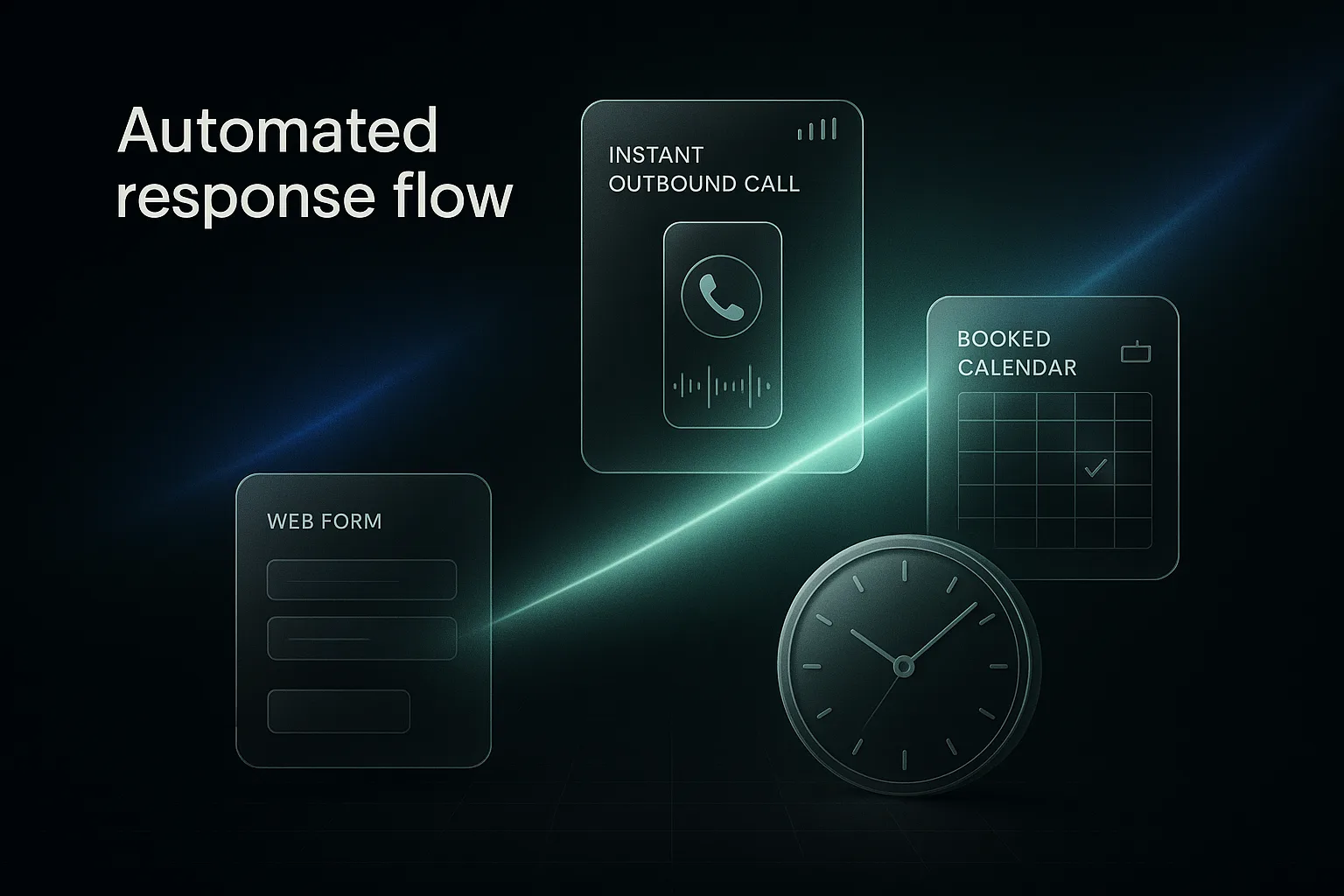
That is what an automated first response is for, and it is worth being straight about what it does. The second a lead fills out your form, an AI can place a call, greet them, ask a couple of quick questions, and either book the appointment or pass it to you with the details already in hand. It handles the first minute so the lead is still warm when a person takes the call that needs a person. It is not pretending to be you. It is making sure the window never closes while you are busy or asleep.
The reason this beats “try harder” is that it removes the human bottleneck from the one step that is most time-sensitive. Your team still does the real selling and the judgment calls. The machine just guarantees the lead hears from someone inside the window that decides everything. If you want to see what that feels like from the customer’s side, the demo is the fastest way to get it, because you become the lead.
Frequently asked questions
Is five minutes a hard cutoff, or does the lead still convert after?
It is not a wall that drops at 5:01. It is a curve, and the curve is steepest at the start. Leads still convert after five minutes, just at much lower rates, and the odds keep sliding the longer you wait. Five minutes is the point where you are still catching most of the value. An hour later you are catching a fraction of it.
We respond same-day. Is that really a problem?
Compared to a competitor who calls in five minutes, yes. Same-day feels responsive because you are comparing yourself to businesses slower than you. The lead is comparing you to whoever reached them first. Same-day usually loses to same-minute.
Does an instant call make us look desperate?
No. The person just asked to hear from you. A fast, friendly call reads as attentive. What actually damages trust is silence, the two days where they wonder if anyone got their message and start calling around.
What about leads that come in overnight?
Those should still get a fast response, kept inside legal calling hours. A good setup calls right away during reasonable hours and lines up overnight leads to be the first calls of the morning, so a midnight lead is at the front of the line instead of buried.
Do we lose the personal touch if software makes the first call?
The first minute is not where the personal touch lives. It is where speed lives. The personal touch shows up in the real conversation, the quote, the judgment, all the parts a human still handles. The software just keeps the lead warm long enough for that human moment to happen.
The bottom line
Five minutes is the rule because that is where the research draws the line. Reach a lead inside it and you are up to 100 times more likely to connect. Miss it and you are usually leaving a voicemail into the void. Most businesses are not close, sitting at an average response measured in hours, which is why “bad leads” is so often just slow response wearing a disguise. You will not fix it by promising to be faster, because no small team can hold that. You fix it by making the first response automatic.
The fastest way to see this is to feel it. Put your number in at rushdial.com and the AI will call you in under a minute, the same call your leads would get the second they hit your form.